
Showing posts with label sculpture. Show all posts
Showing posts with label sculpture. Show all posts
May 31, 2011
May 25, 2011
Hepworth and the 'primal'
Using primitive or platonic shapes
There was a program about Barbara Hepworth on television last week (The Culture Show on BBC), and I have been thinking about it since. It included some black and white footage of Hepworth at work, and audio of Hepworth speaking about herself, her practice, and art in general. I did not see the full show as I had to go out on a previously engaged bike ride. Unfortunately I can not find the show online, but here is another interview by Hepworth:
Perhaps it was a fair sacrifice--giving up the TV program for riding the bike in fresh air--one Hepworth might make herself, considering she was interested in the nature and landscape. She also used a word akin to primitive, primary, primordial, primal, or eternal on the show. I can't be sure which word it was anymore... I am thinking about the primary shapes myself: the circle, triangle, square. I do like them. Plus I find it amazing just how many painters and draftsmen/women are turning to the primitives as a subject. I enjoy their work as well. But a bee buzzes somewhere...
The question of existence,
The question of existence as an artist,
The question of existence of an artwork made by the artist,
Is there an eternal, spiritual, primal, abstract, concentrated answer to these questions? One can 'feel' these questions, and proceed to 'think' of them. To feel their answer in a primary form, a platonic form, a form smoothened or neutralized... I am not sure...
John Berger has a lovely essay on Brancusi and his forms in the book 'The Shape of a Pocket' [121-7]. In describing a blind person's reactions when holding Brancusi's 'Sculpture for the Blind,' Berger imagines them asking, "Is this thing I'm holding a container or a core?" Berger says that when carving Brancusi "wanted to go back, eliminating all imperfections, all wear and tear, to the growing point of the first Creation, to the pure idea as it takes on form. Platonic once more." Berger feels when the sculptor succeeded when he created a core. But Berger brings up the question that Brancusi might himself have felt, i.e. how long can one keep pursuing the platonic?
Hepworth's interviews brought up the word 'primal.' And that brings up for me the search for meaning... it troubles me, or perhaps it calls me... It calls me because I know that question. It troubles me because firstly because the word 'primitive' etc seems to have a colonial ring to it. And also I am realizing that a platonic shape can not exist in reality, it may only seem to exist in representation. And as no perfection is possible... 'perfection' of form is imperfect. [Imperfection as texture or pattern... that is an interesting idea.] Maybe I feel that tool marks on an imagined platonic form are a ruse, not a testimony to a human spirit that is reaching towards that which is perfect. The form really must be imperfect, more unique. Of course it all depends on the point of view, and what carries an urgency on a person to person, situation to situation basis. I need to see and read a bit more about Hepworth to see what she was after. Maybe it will help me figure out the same for me.
There was a program about Barbara Hepworth on television last week (The Culture Show on BBC), and I have been thinking about it since. It included some black and white footage of Hepworth at work, and audio of Hepworth speaking about herself, her practice, and art in general. I did not see the full show as I had to go out on a previously engaged bike ride. Unfortunately I can not find the show online, but here is another interview by Hepworth:
Perhaps it was a fair sacrifice--giving up the TV program for riding the bike in fresh air--one Hepworth might make herself, considering she was interested in the nature and landscape. She also used a word akin to primitive, primary, primordial, primal, or eternal on the show. I can't be sure which word it was anymore... I am thinking about the primary shapes myself: the circle, triangle, square. I do like them. Plus I find it amazing just how many painters and draftsmen/women are turning to the primitives as a subject. I enjoy their work as well. But a bee buzzes somewhere...
The question of existence,
The question of existence as an artist,
The question of existence of an artwork made by the artist,
Is there an eternal, spiritual, primal, abstract, concentrated answer to these questions? One can 'feel' these questions, and proceed to 'think' of them. To feel their answer in a primary form, a platonic form, a form smoothened or neutralized... I am not sure...
John Berger has a lovely essay on Brancusi and his forms in the book 'The Shape of a Pocket' [121-7]. In describing a blind person's reactions when holding Brancusi's 'Sculpture for the Blind,' Berger imagines them asking, "Is this thing I'm holding a container or a core?" Berger says that when carving Brancusi "wanted to go back, eliminating all imperfections, all wear and tear, to the growing point of the first Creation, to the pure idea as it takes on form. Platonic once more." Berger feels when the sculptor succeeded when he created a core. But Berger brings up the question that Brancusi might himself have felt, i.e. how long can one keep pursuing the platonic?
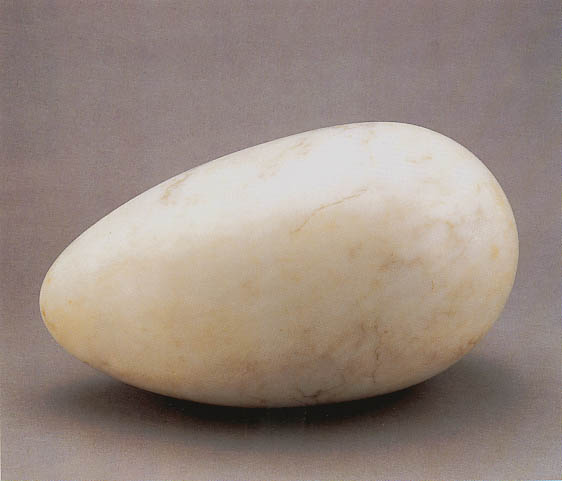 |
| Constantin Brancusi Sculpture for the Blind ca. 1920 Veined Marble |
Hepworth's interviews brought up the word 'primal.' And that brings up for me the search for meaning... it troubles me, or perhaps it calls me... It calls me because I know that question. It troubles me because firstly because the word 'primitive' etc seems to have a colonial ring to it. And also I am realizing that a platonic shape can not exist in reality, it may only seem to exist in representation. And as no perfection is possible... 'perfection' of form is imperfect. [Imperfection as texture or pattern... that is an interesting idea.] Maybe I feel that tool marks on an imagined platonic form are a ruse, not a testimony to a human spirit that is reaching towards that which is perfect. The form really must be imperfect, more unique. Of course it all depends on the point of view, and what carries an urgency on a person to person, situation to situation basis. I need to see and read a bit more about Hepworth to see what she was after. Maybe it will help me figure out the same for me.
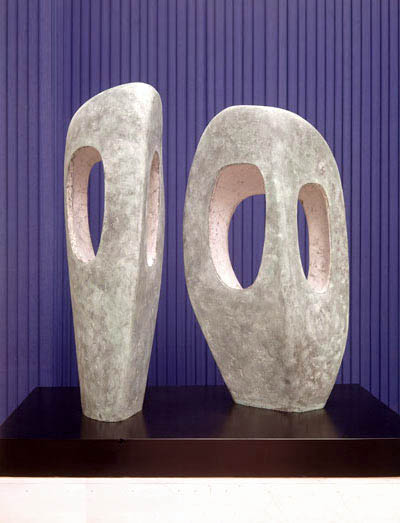 |
| Barbara Hepworth, Two Forms in Echelon, Bronze, 1961 |
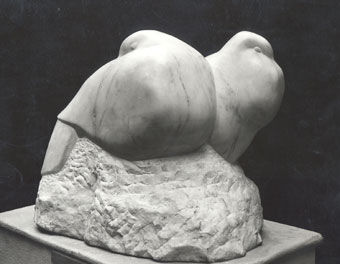 |
| Barbara Hepworth, Doves (Group), Parian marble, 1927 (BH 3), Manchester City Art Gallery |
January 21, 2011
grad friends
Writing a bit each day is wonderful. I actually am remembering where I left my art practice. Sounds strange... but I tend to terrible forgetfulness, especially with all the geographical shifts.
I have been thinking very much of my four graduate school colleagues. They are all wonderful artists. Here is an image of the project called Smile Generator by Peter Goff who went to Malawi in 2009 on a Fulbright Grant. He has a talk today on the project: good luck to him! From what I gather in the writing, the Smile Generator was a goat. I am smiling. The other image of the sculpture is from our graduate show at the Weatherspoon. Peter always has a delicate line somewhere...
I think of Katie's drawings and painting all the time nowadays. She had such a light touch, and in my memory she spent her entire graduate career taming the ephemerality of space in her work--well taming it enough so she could catch an image of it, but the space it seems (inside and outside a body) will always be wild and intimate at the same time. I wanted to post her drawings too, but can't get a link to them...
Jeff has a new body of work since graduate school as well. His sculptures are an amalgamation of memory and material. Even though Jeff and I probably had vastly different childhoods, there is something about his work that makes me nostalgic for my toys and fantasies from when I was little. I always wanted his sculpture the 'Rider' (pictured below) for myself. I wish I wasn't always moving all over, so I could carry and keep my friends' work with me. Soon perhaps...
Kelly's work just is. I remember how she even stuck feathers and sequence on her painting once--it was like a painted party! Very intelligent, honest, and colorful. Kelly's studio was right next to mine and whenever I would step in Kelly was of on some other adventure in space and form, sometimes a large painting sometimes little tiny ones. Latest from her blog post, she was gathering text into her paintings.
Have to exchange and collect my friends works soon!
I have been thinking very much of my four graduate school colleagues. They are all wonderful artists. Here is an image of the project called Smile Generator by Peter Goff who went to Malawi in 2009 on a Fulbright Grant. He has a talk today on the project: good luck to him! From what I gather in the writing, the Smile Generator was a goat. I am smiling. The other image of the sculpture is from our graduate show at the Weatherspoon. Peter always has a delicate line somewhere...
 |
| Peter Goff, Smile Generator (Eating), 2009 |
 |
| Peter Goff, chew-drive-comb, 2008 |
I think of Katie's drawings and painting all the time nowadays. She had such a light touch, and in my memory she spent her entire graduate career taming the ephemerality of space in her work--well taming it enough so she could catch an image of it, but the space it seems (inside and outside a body) will always be wild and intimate at the same time. I wanted to post her drawings too, but can't get a link to them...
 |
| Katie Claibourne, 2008 (can't find title) |
 |
Jeff has a new body of work since graduate school as well. His sculptures are an amalgamation of memory and material. Even though Jeff and I probably had vastly different childhoods, there is something about his work that makes me nostalgic for my toys and fantasies from when I was little. I always wanted his sculpture the 'Rider' (pictured below) for myself. I wish I wasn't always moving all over, so I could carry and keep my friends' work with me. Soon perhaps...
 |
| Jeff Bell, Recent Work (Divide) (2010) wood, fabric. |
 |
| Jeff Bell, Rogue Series (Rider) (2007) steel, paint. |
Kelly's work just is. I remember how she even stuck feathers and sequence on her painting once--it was like a painted party! Very intelligent, honest, and colorful. Kelly's studio was right next to mine and whenever I would step in Kelly was of on some other adventure in space and form, sometimes a large painting sometimes little tiny ones. Latest from her blog post, she was gathering text into her paintings.
 |
| Kelly Queener, 2010, (can't find the title) |
 |
| Kelly Queener, 2010, (can't find the title) |
Have to exchange and collect my friends works soon!
January 12, 2011
pfaff and scale


Judy Pfaff, "Umidum", 2011, honeycomb cardboard, wire frame, expanded
foam, shellac, sunflowers, tree fungus, paper lanterns, approx. 128 x 162
x 36 in. Courtesy of the artist and Ameringer, McEnery, and Yohe, New
York.

Judy Pfaff, Flusso E Riflusso 1992 Steel, wire,
wood and paint 12 feet x 25 feet x 20 feet
Max Protetch Gallery, New York, NY
Judy Pfaff will have a show at the Weatherspoon Museum soon. Since I am thinking of starting a large scale drawing, her work seems very relevant to look at. Materials ooze out of Ms. Pfaff--varying in color and density. I am not sure whether her drawings are like landscapes, or have a dynamic movement in them--perhaps they are shifting. An interesting one to look at is her 2009 drawing Rosie's Bed. Her sculptures and installations are tense with momentum. Aware of space, they seem to crystallize the concept of aggressive and graceful growth in nature (and otherwise?). Each surface of her drawing, individually deserves to be called prolific.

Her studio looks amazing as well... so large. I can only imagine all the material skills she has acquired through her approximately 30 years of artistic career. I am slightly envious! Some very interesting videos of Pfaff at work can be seen on the Art 21 website.


Judy Pfaff, . . . all of the above
2007 Ameringer/Yohe Fine Art, New York, NY.
January 5, 2011
prolific hesse
It is amazing to see the work of prolific artists. I don't know what the painting above by Eva Hesse is called, or how large it is. I'll update this post once I find out. A city of marks made on this one surface. Each mark seems to be a note for a new sculpture. A city of sculptures. Here is a famous saying by Sol Lewitt to Hesse that seems to capture the prolific nature of her work.
The artist came to my mind because I overheard friends talking about this exhibition at the Hammer Museum called Eva Hesse Spectres 1960, and because her drawings were part of the On Line exhibition at MOMA. She is on the mind of many no doubt.
I love the little painting from the Spectres exhibition at the end of this post. The belly is made with a multicolored brush stroke--a whoosh. It belongs to the darker body, and becomes from the leg and merges into the arm...


The artist came to my mind because I overheard friends talking about this exhibition at the Hammer Museum called Eva Hesse Spectres 1960, and because her drawings were part of the On Line exhibition at MOMA. She is on the mind of many no doubt.
I love the little painting from the Spectres exhibition at the end of this post. The belly is made with a multicolored brush stroke--a whoosh. It belongs to the darker body, and becomes from the leg and merges into the arm...


Subscribe to:
Posts (Atom)